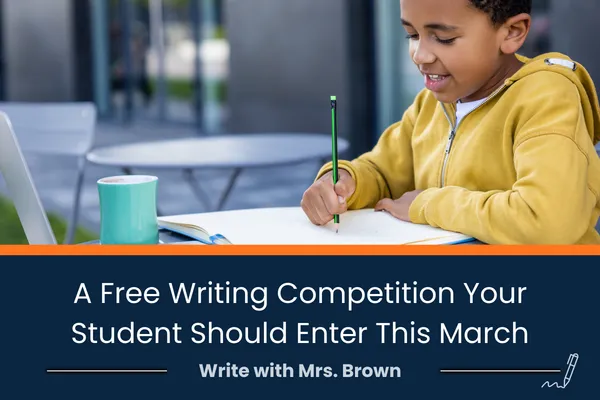
A Free Writing Competition Your Student Should Enter This March
No submission fees. No experience required. Just your student's voice and a deadline worth working toward.
One of the most powerful things you can do for a developing writer is give them a real audience.
Not a parent. Not a teacher. A real audience — with judges, prizes, and the possibility of seeing their name in print.
That is exactly what the Future Scholar Foundation's monthly short story competition offers. And I want every family on my list to know about it.
Here is everything you need to know to enter your student this month.
What Is the Future Scholar Foundation Competition?
The Future Scholar Foundation runs a monthly short story competition open to elementary and middle school students. Every month a new prompt is released, students write a story of 350 words or less, and a panel of judges — including a guest author — selects winners for prizes and publication.
There are no submission fees. No barriers. Just a prompt, a deadline, and the chance to compete alongside student writers from across the country.
Competition At a Glance
Who can enter: Elementary and middle school students
Cost: Free
Word limit: 350 words or less
Prompts released: 1st of every month
Submission deadline: 28th of every month, 11:59pm PST
Early submission deadline:10th of the month (for free feedback)
Results released: 1st of the following month, 8:00am PST
Contact: [email protected]
The Prizes
Awards
1st Place— $60 Amazon Gift Card + published in the Hall of Fame
2nd Place— $40 Amazon Gift Card + published in the Hall of Fame
3rd Place— $20 Amazon Gift Card + published in the Hall of Fame
Runner Up— Published in the Hall of Fame
Publication matters as much as the prize money. When a student sees their name attached to a piece of writing that judges selected, that changes how they see themselves as a writer. It is a credential they carry forward.
This Month's Prompt
March 2026 Prompt
Your main character finds themselves somewhere they have been a hundred times before. Yet they soon notice a door they have never seen there. It isn't hidden — in fact, it's fully in plain sight. When your main character asks, everyone around them insists that the door has always been there. Soon, something makes your protagonist reach for the handle and open the door. Write a story about what happens next. What does your main character find on the other side?
This is a beautifully open prompt. There is no single right answer — which means your student's individual voice has room to show up on the page. That is exactly the kind of prompt strong writers thrive on.
March's guest judge is Adrianna Cuevas — award-winning author of the Pura Belpré honor bookThe Total Eclipse of Nestor Lopezand the Edgar Award-winningThe Ghosts of Rancho Espanto. A first-generation Cuban-American and middle school ESOL teacher, she brings a reader's eye and an educator's heart to the judging process.
How to Enter
01
Read the prompt
Visit the Future Scholar Foundation website and read the March prompt carefully. Talk through the starter questions together before your student writes a single word.
02
Write and revise
Keep the story to 350 words or less. If your student submits before the 10th they can receive free feedback and resubmit before the final deadline. Use that window — it is a gift.
03
Submit by the 28th
Final deadline is March 28th at 11:59pm PST. Results are released April 1st at 8:00am PST in the Hall of Fame.
Note: This month the Foundation is unable to provide feedback on early submissions due to staffing shortages. Submit your best draft by the 28th and let the story speak for itself.
Why This Competition Is Worth Your Time
I recommend this competition to my students and their families for one reason above all others: real deadlines produce real writing.
There is something that happens when a student knows their work will be read by someone other than their parent or teacher. The stakes shift. The effort shifts. The care they bring to word choice, to their opening sentence, to their ending — all of it changes when the audience is "real."
That is not pressure. That is purpose. And purpose is one of the most powerful writing teachers there is.
350 words is also the perfect length for a developing writer. It is short enough not to overwhelm. Long enough to demand structure, voice, and a story that actually goes somewhere. Your student cannot ramble their way through 350 words and win. They have to make every sentence count.
That discipline of choosing what stays and what goes is one of the hardest and most valuable things a writer learns.
One More Thing Before You Go
If your student struggles to know where to start with a prompt like this one, that is a structure problem, not a creativity problem. The students I work with in my foundations class learn to approach any prompt with a plan before they write a single word. That habit is what separates the students who freeze from the students who write and win.
If you want to know more about how that foundation is built, I'd love to show you. Join me Tuesday at 7pm for a free one-hour training: From Struggling to Scholarship-Ready.
— Alicia Brown
Write with Mrs. Brown | Raising Writers
Learn more about the Future Scholar Foundation competition at futurescholarfoundation.com